Closer to Nature
2016-2019 · Technical support engineer
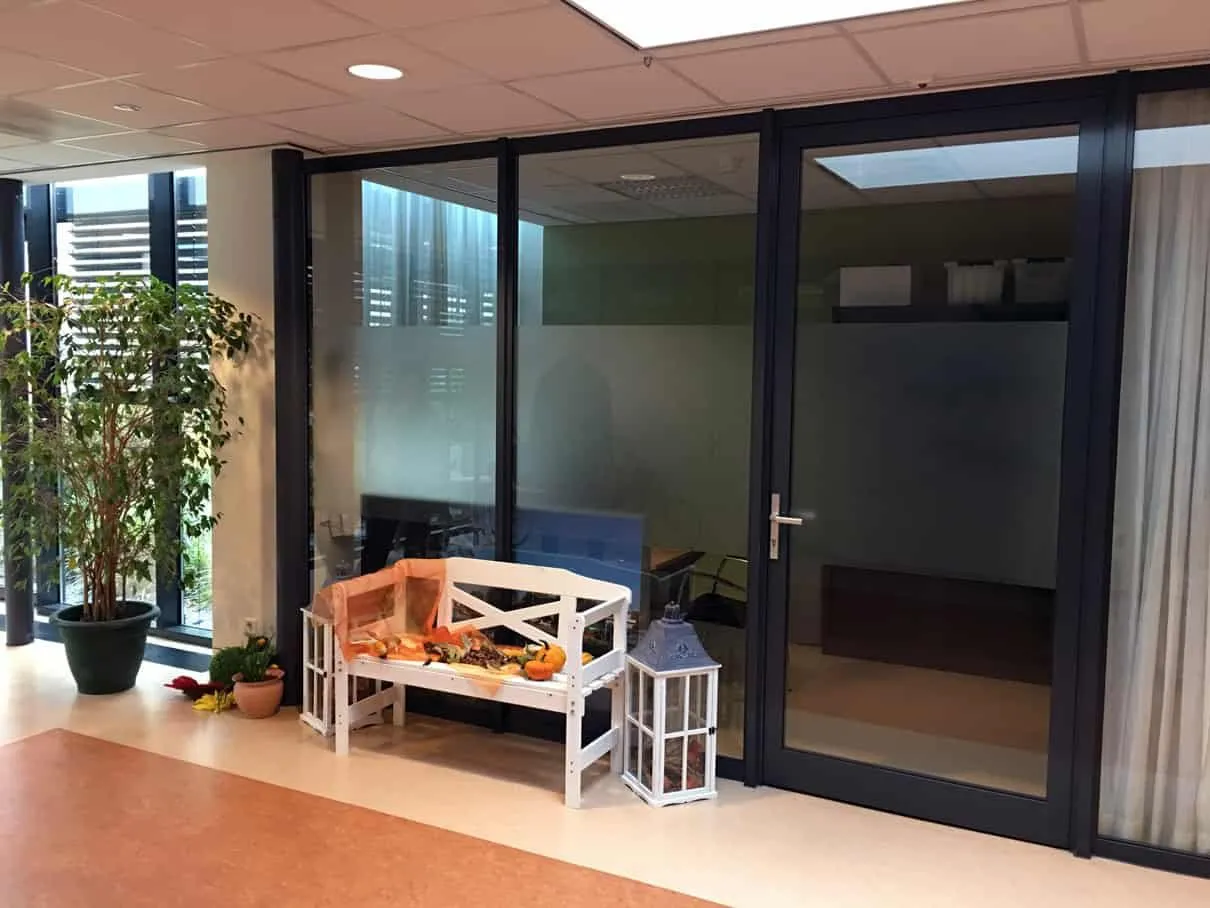
People with dementia who live on a closed ward rarely get outside. The door has a code, and going out means being accompanied. Much of the day passes with nothing to do, and that lack of engagement goes together with agitation, apathy and depression.
Closer to Nature brings the outdoors in. It is an interactive nature experience for seniors with dementia in long-term care, built as a permanent part of the common space at Vitalis Berckelhof in Eindhoven. It iterates on the first concept by Carlijn Valk and was taken further afterwards by Yuan Feng.
What a resident finds
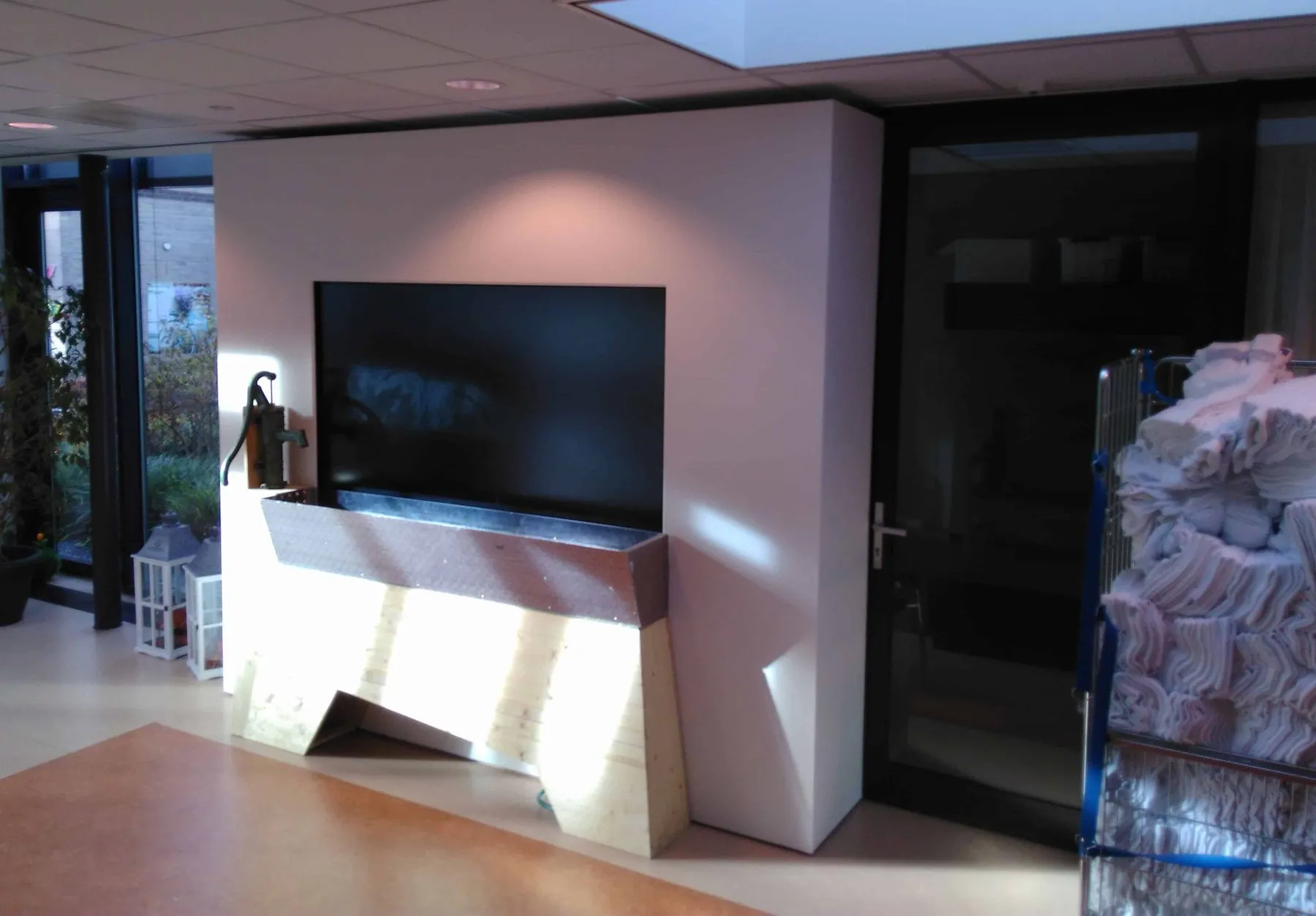
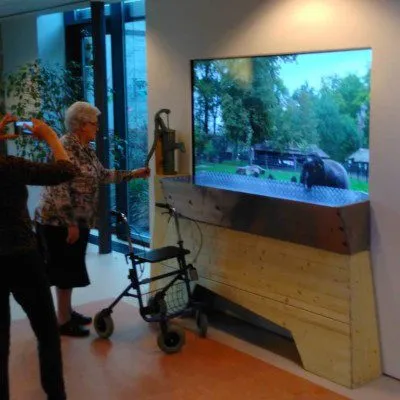
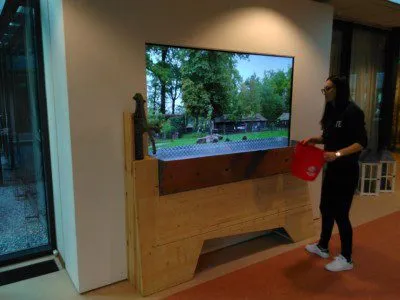
A wall with a large display in it, made to look like a window onto a Dutch farm. In front of it stands an old-fashioned water pump beside a metal trough holding real water, and the trough carries on into the picture. Work the pump, and the animals come to drink.
Nothing needs explaining and nothing can be done wrong. The interaction is one familiar movement, with a low threshold on purpose, so that it suits people at any stage of dementia. It is there at any hour, to be used with a carer or a visiting family member, or alone.
What I built
As technical support engineer I redesigned the whole application. Only the video material carried over from the previous version: the audio and the visuals were rebuilt, driven by external sensors. I helped design and build the physical installation as well.
Made to last
A prototype has to work for a demonstration. This had to work in a care home, around the clock, for people who cannot be asked to be careful with it.
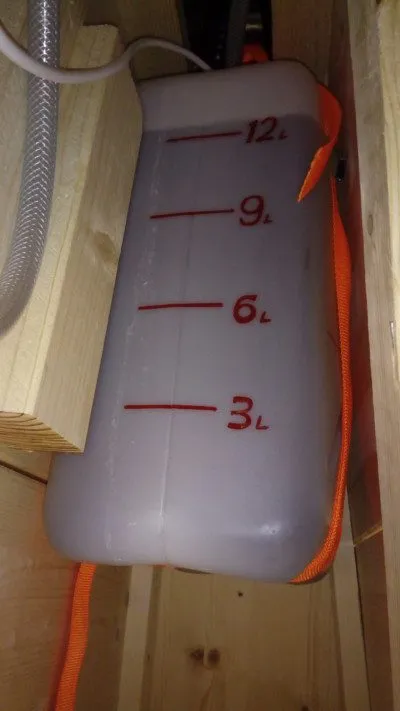
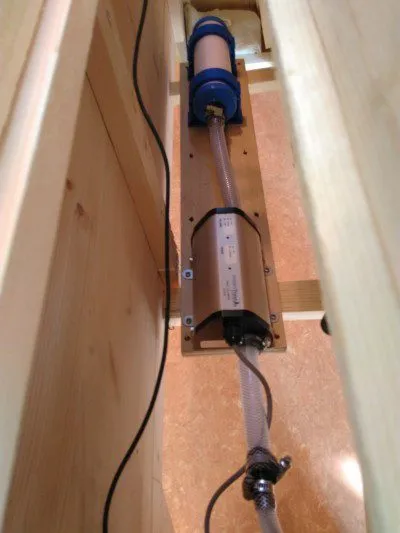
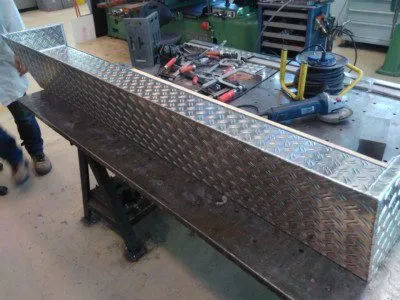
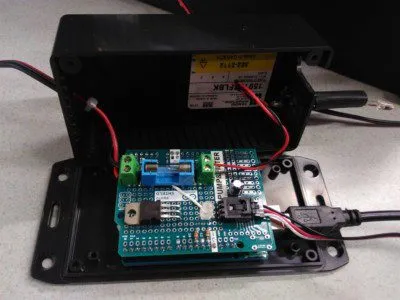
An infrared sensor in the pump registers the movement, and the software recognises continuous pumping and answers with one of nine videos of different animals, chosen at random without repeating itself. A computer hidden behind the wall runs permanently, with an Arduino controlling the pump, the filter and the sensors. The water circulates through a filter that keeps it at drinking quality, because residents touch it and may drink from it. The trough has no sharp edges, and the wall is weighted so that it stands firm when someone leans on the pump. Use is logged, and logs and updates go over a remote connection, so that residents rarely see anyone doing maintenance.
What residents made of it
After four weeks of free use, fifteen residents aged 79 to 97, four family members and two professional caregivers were interviewed in front of the installation.
Fourteen of the fifteen residents showed excitement, even surprise, when the animals came to drink. Twelve started telling stories of their own. Seven began pumping without any help. One resident, who grew up on a farm, said: “Every time I pass by, I come here to pump to see the sheep, they remind me of my beautiful youth.” A daughter said of her mother: “She is addicted to the pump.”
It did not work for everyone. One resident found the metal pump too heavy, and not all of them could start without help. That is where the next concept came from: a goat figure covered in touch sensors, something to stroke rather than something to operate.
Who built it
The original prototype came out of concept exploration by Carlijn Valk and Xu Lin. Yuan Feng took it further. Jasper Loeff ran the user study, and the plaster goat concept was the work of G. Feijóo Carrillo, B. Gorini, E. Rizvi and E. Zanus. The residents, families, volunteers and staff of Vitalis Berckelhof took part.
Published as Yuan Feng, Suihuai Yu, Dirk van de Mortel, Emilia Barakova, Matthias Rauterberg and Jun Hu, “Closer to nature: multi-sensory engagement in interactive nature experience for seniors with dementia”, Chinese CHI 2018, pp. 49–56. The figures and quotations above are from that paper.
The concept it grew from was published first as Carlijn Valk, Xu Lin, Loe Feijs, Matthias Rauterberg and Jun Hu, “Closer to Nature: interactive installation design for elderly with dementia”, ICIC 2017.
What came of it
Published at Chinese CHI 2018, and the work continued: the same group took the idea further as LiveNature, which joined the display to an interactive robotic sheep, published at DIS 2019 with me among the authors. Both are on the publications page.
The installation outlived the job. I kept it running at the care home until 2024, when it was handed over to someone else.