Memories Sharing
2018 · Software infrastructure and narrowcasting
Someone in a care home writes a postcard about something they remember. That part is easy. Everything after it is not: getting the words off the paper, onto a screen, out to people who are not in the building, and then getting what those people say back into the room while it is still a conversation rather than an archive.
In the first iteration of this idea every one of those steps was done by hand. My work was turning it into a system that ran on its own.
What I built
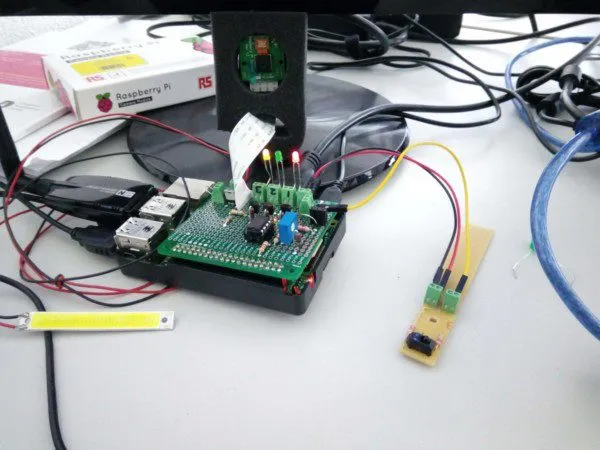
The post box was fitted with a Raspberry Pi 2 and a camera module. Sensors watched for a new entry: wait for the postcard to drop, flash, photograph, upload, ready. The photo then appeared in a CodeIgniter CMS, where a story could be created around it and the details added: title, text, date, author, tags, location.
A tweet is prepared automatically and sent on request with a picture. It keeps its tweet ID and checks for new replies regularly, and the same for the Facebook story. Details can be added or changed later, and the change is reflected on the tweet, the Facebook post and the narrowcast on the screen.
For the screen, the system looks for stories to display, with images and Google Maps as the background. A filter shows only stories with certain tags, in a carousel. While the story text scrolls slowly past, the fetched social media replies and attached pictures are shown more quickly alongside it.
The whole path: Raspberry Pi 2, image, CodeIgniter CMS, postcard image, entry details, tweet and Facebook post, narrowcast screen, and back to conversation on Twitter, Facebook and in the room.
The research it served
During her PhD research, Xu Lin worked on increasing the involvement of elderly people, to improve their quality of time in the care home. In an earlier project she tested an idea where three imitation bricks with cameras and an internet connection were placed at the nicest spots in Eindhoven, with the images shown on screens in the care home. A push of a button printed the image on a postcard. The intention was that the images would relate to the person and evoke thoughts of their childhood, or of where they last lived.
Xu Lin, together with master’s student Xuechen Liu, then came up with a new idea: people in the care home write postcards about whatever they are thinking of, encouraged to share a story from their past. The postcard is posted in the designated box, digitised, OCR’ed, given GPS coordinates where possible, and shared as a tweet and on Facebook. The story and its details show up on a website and on a big screen in the care home, so that others can read it and talk about it. Because of the nature of tweets it also gathers replies from elsewhere, which are fetched and shown alongside the story.