ApartGame console (AGC)
2003 · Developer
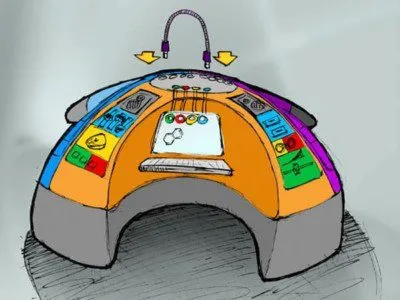
The first concept sketch: an arched console with coloured control panels either side of a central screen, before the form settled into a full circle.
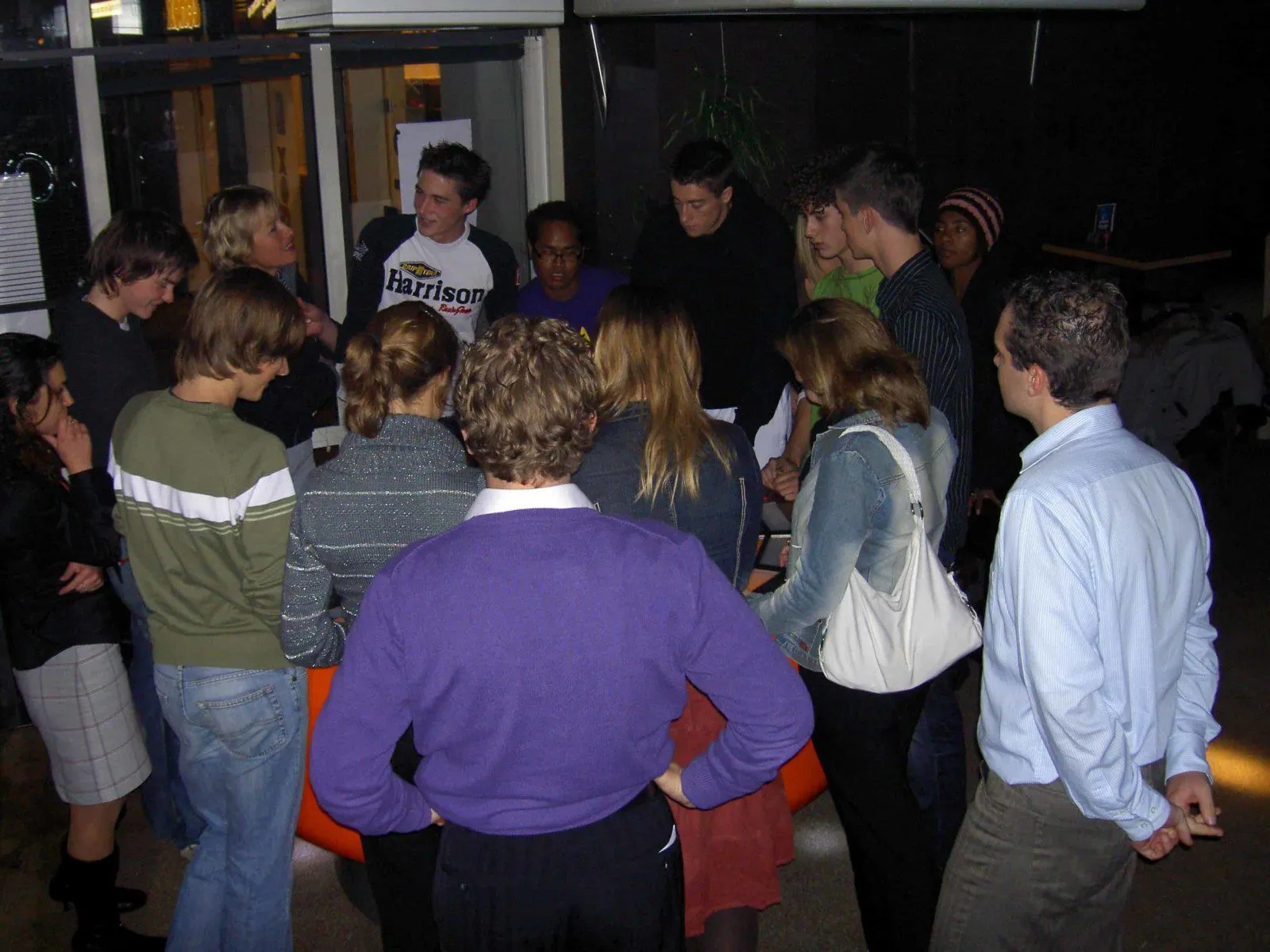
As part of the European Media Master of Arts (EMMA) programme at the Utrecht School of the Arts (HKU), we developed the “Apart” gaming table in 2003 for our thesis project, after building the ScratchWorx installation. We had found a new direction in gaming: a table combining the fun of board games and computer games into simple, physical, challenging play. Be active. After the first prototype we ran user tests in many different settings and locations across Europe.
What happened when it was taken to market is on its own page, O-Dynamic Games.
How you play it
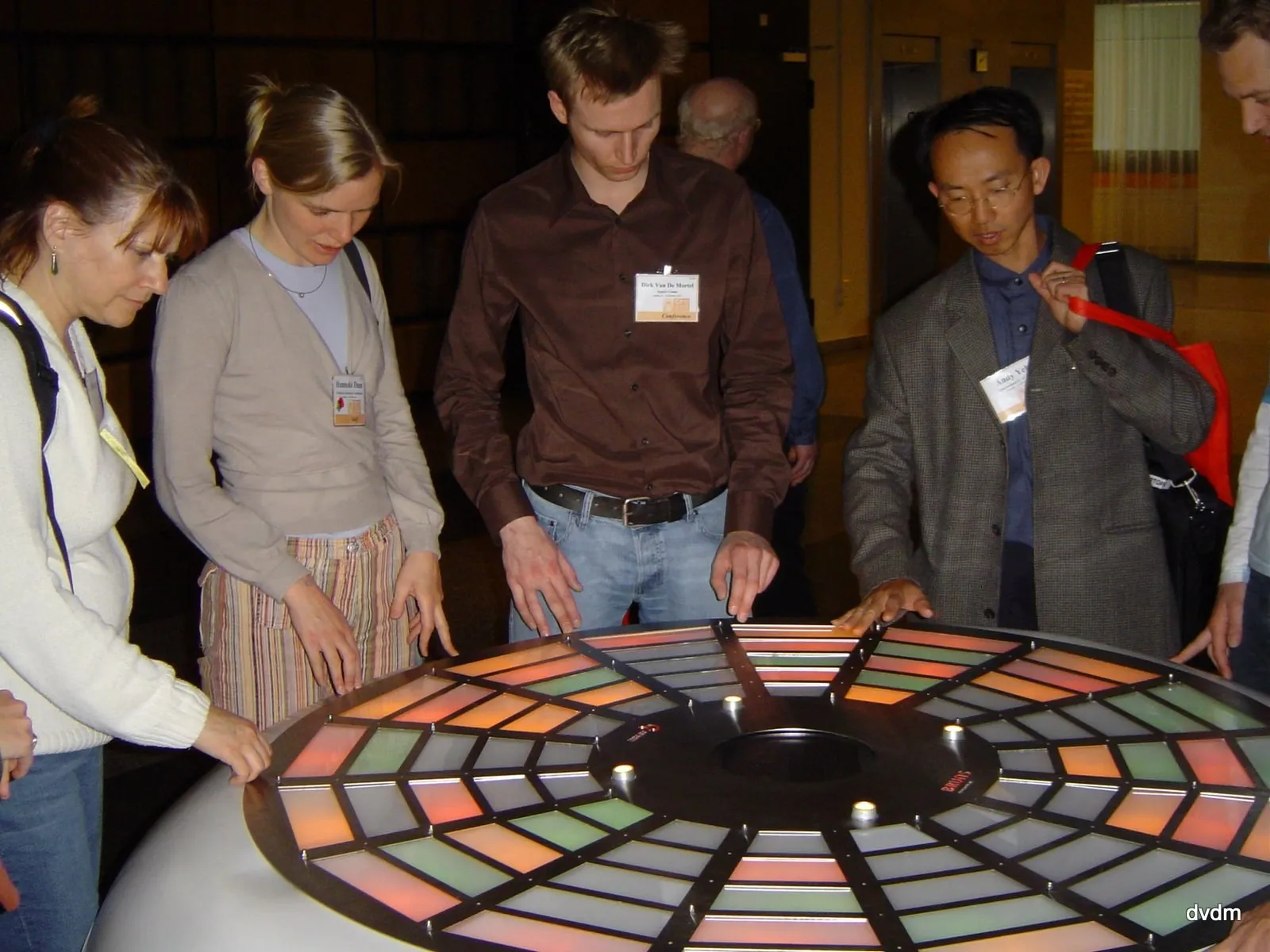
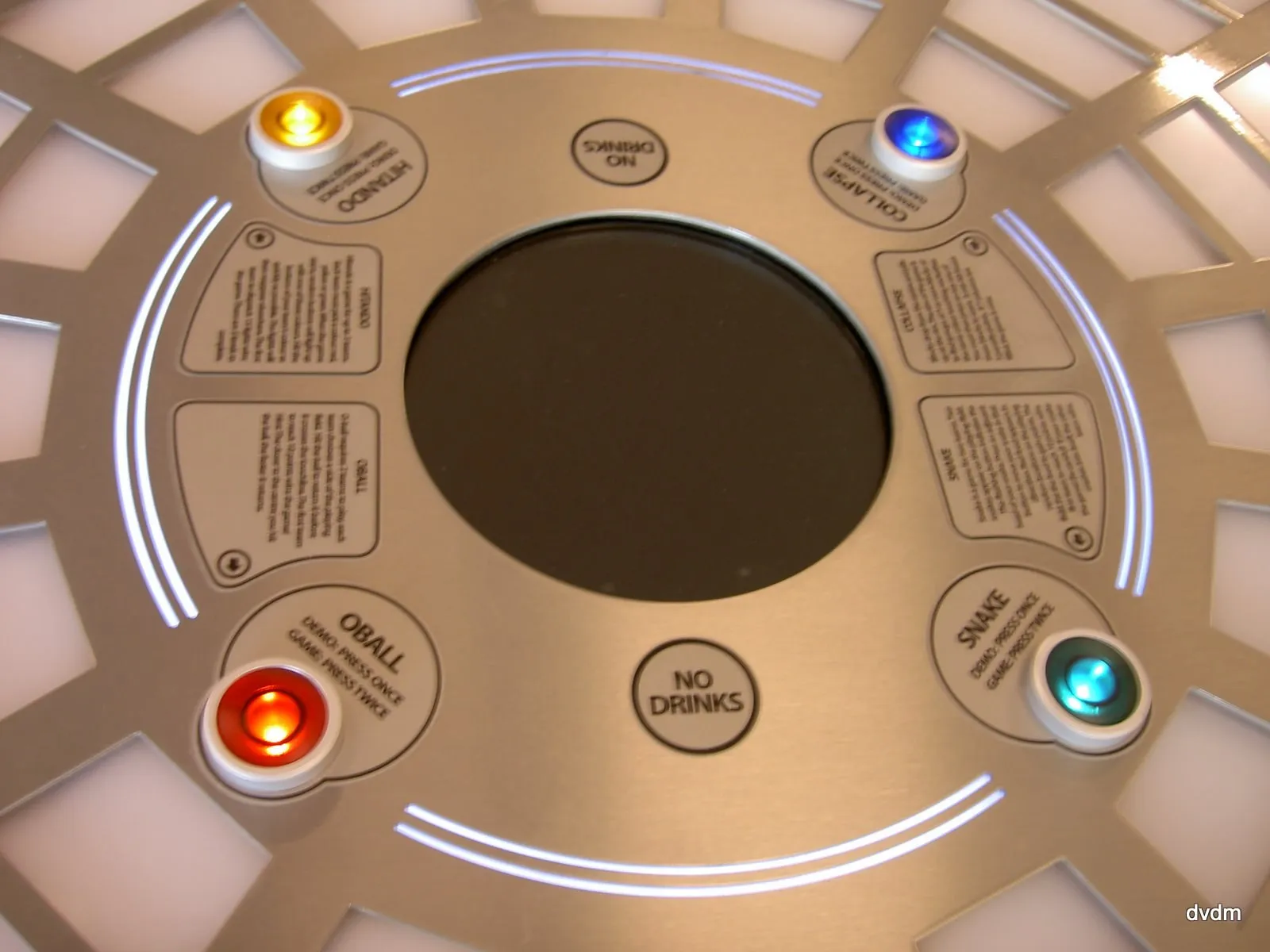
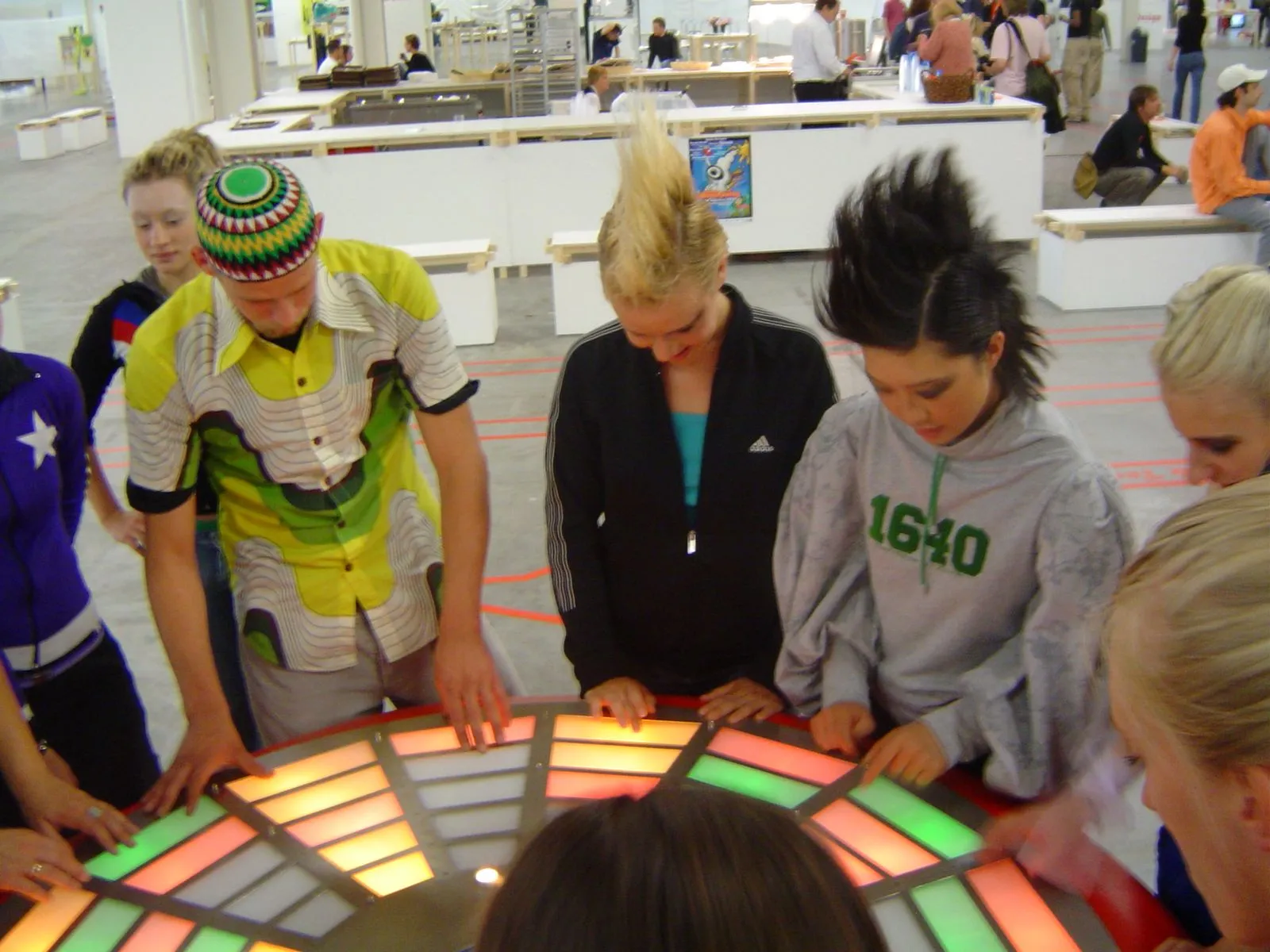
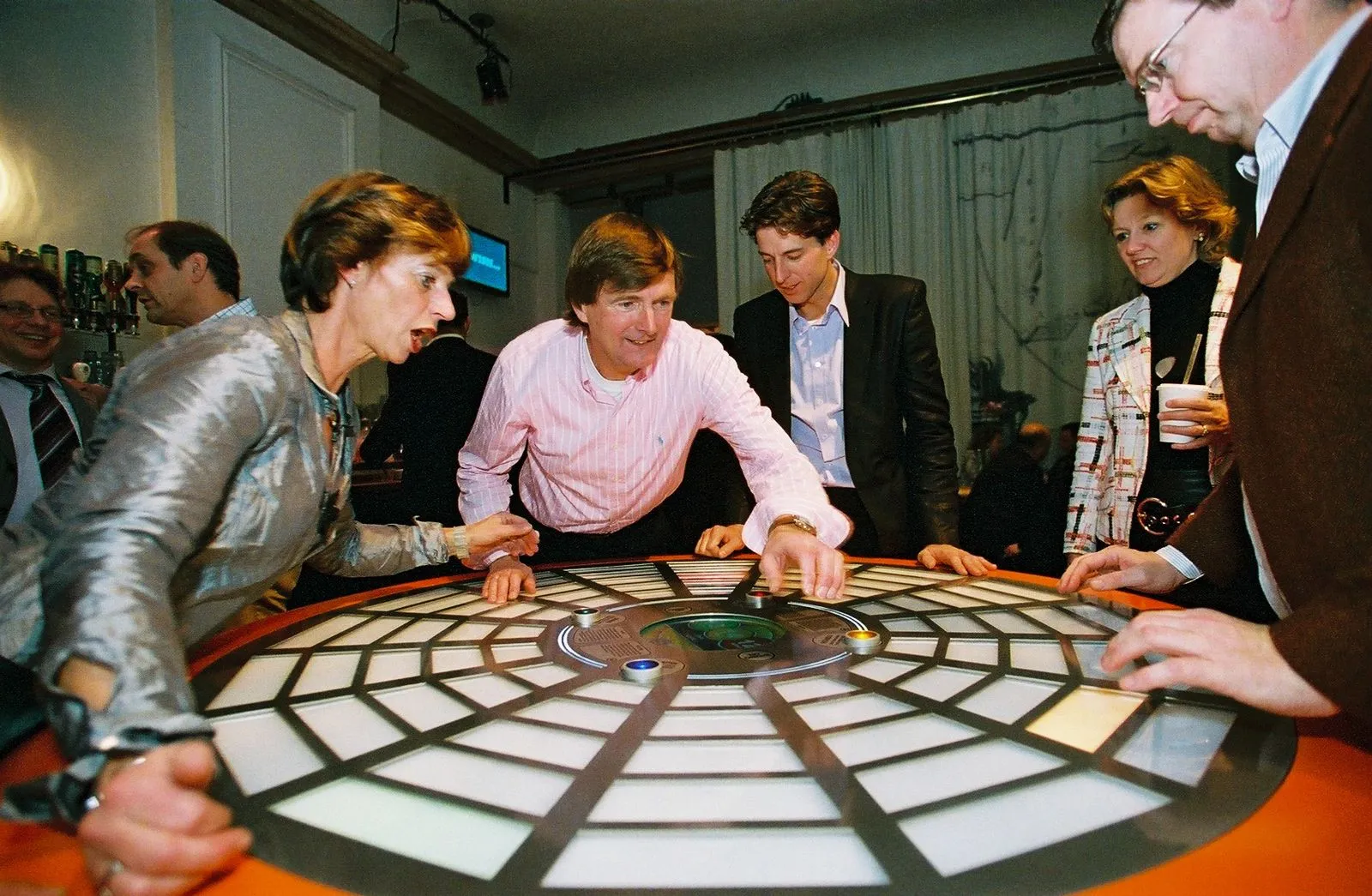
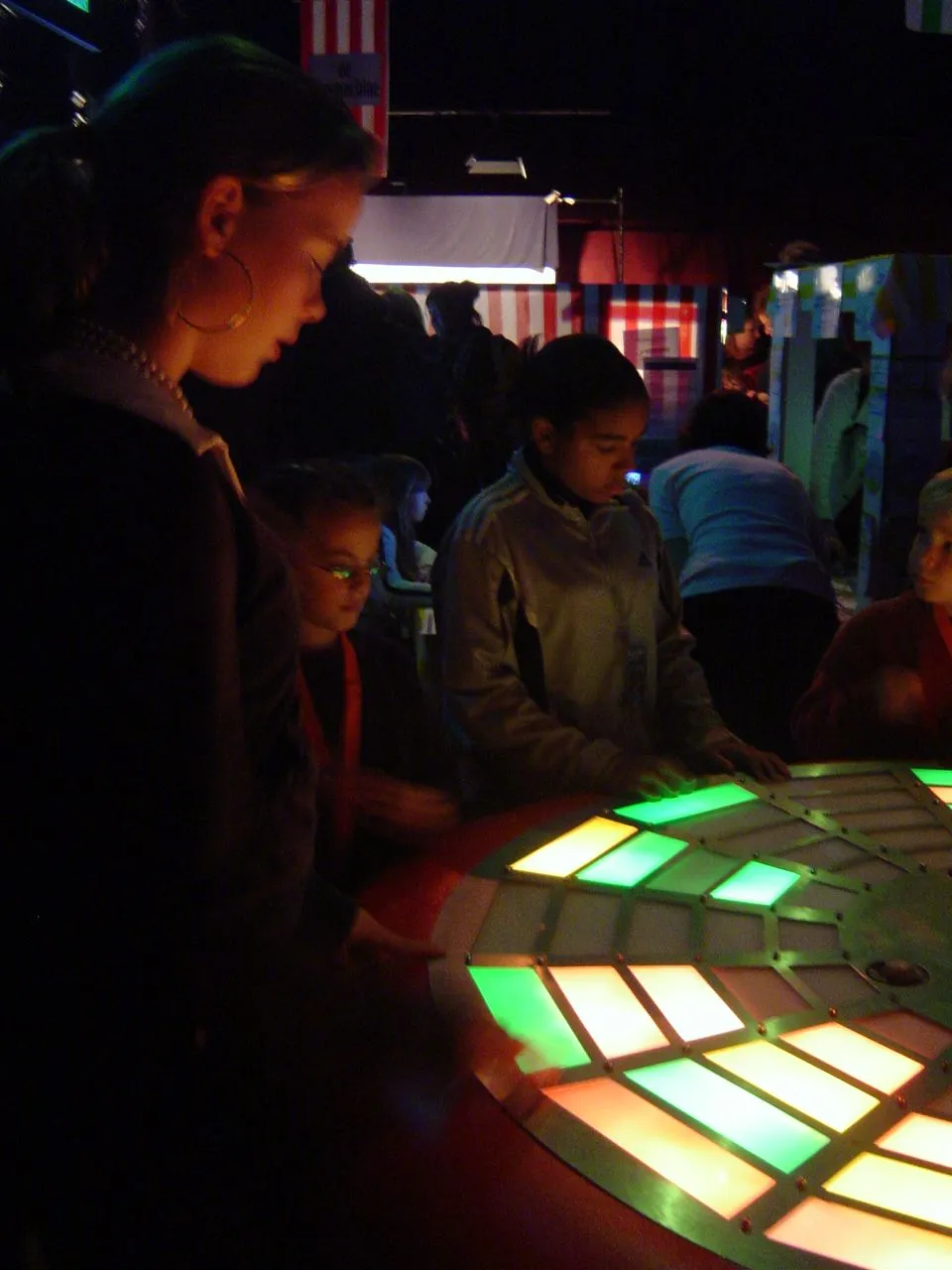
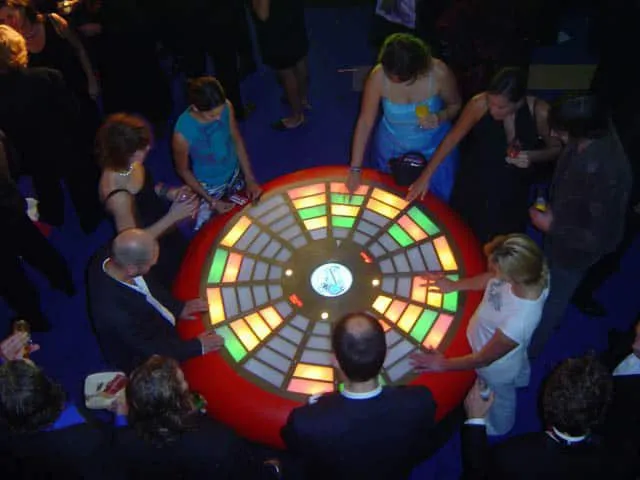
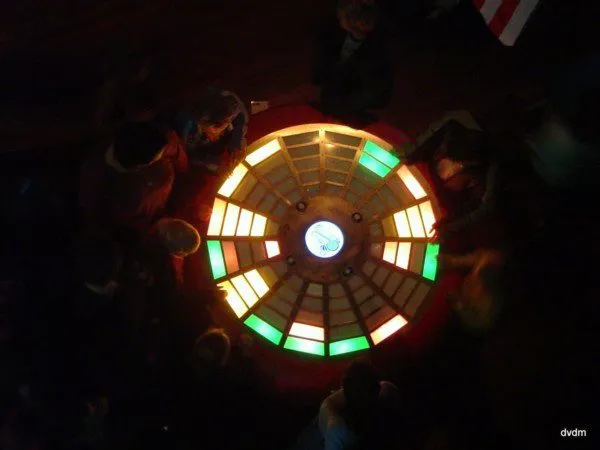
Eighty concentric illuminated push buttons, large at the rim and smaller toward the centre. In the middle, a screen carrying the explanation and the feedback, with speakers and a subwoofer built in behind it, and four large round buttons around it, one per game.
Starting a game takes two presses of the same button. The first puts the explanation on the screen; press it again within five seconds and the game begins. After that the eighty cells are the game, each one meaning something different depending on what is running, lighting in red, yellow or green.
The table serves one player, or as many as fit around it, with or against each other. The first games were not written for a bar at all: they were therapy for children with motor impairments, and the general social games came afterwards.
There were twelve games when the first prototype went public in 2003. The production version shipped with four. The difference is what came of watching people play in public, and keeping only what held up.
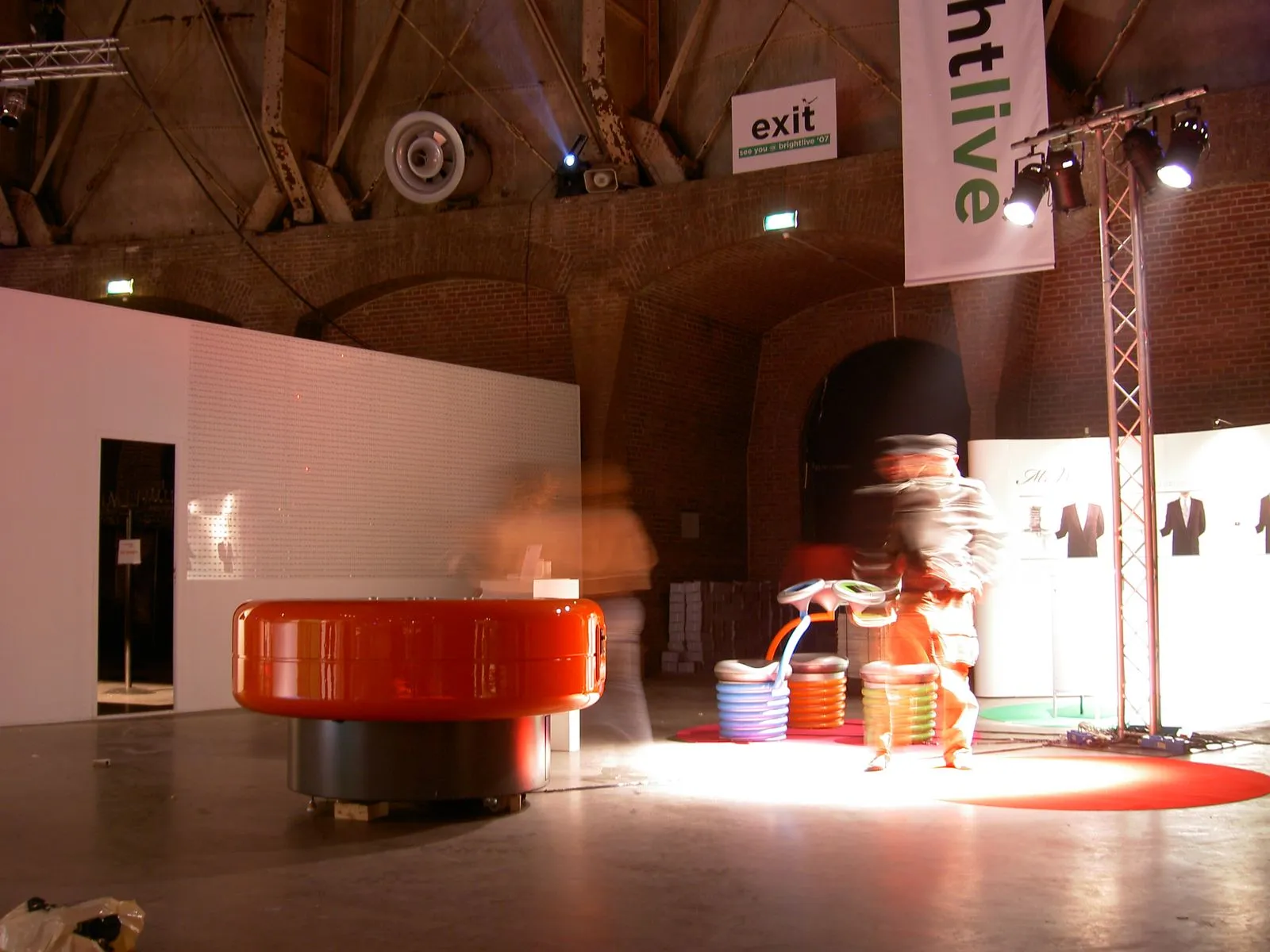
Two of the tables still exist. One lives in an arcade in Scheveningen. The other belongs to the people who made it.
The games
Four games shipped on the table, each explained on a die-cut card shaped like one of the table’s own sectors. The printed sheet is here.
Collapse. Blocks drop from the centre and pile up at the rim. Find groups of three or more blocks of the same colour touching each other, then press any one of them to score. A mis-hit costs five penalty points. If seven columns fill up, the game is over.
Hitando. For up to three teams. Each team picks a colour: red, yellow or green. Random buttons light up in those colours; hit your team’s colour as quickly as you can and the lights reappear elsewhere. First team to dispatch fifteen lights wins. Three levels.
Snake. Two teams, two snakes. The flashing button is your head; press an adjacent button to move that way. Red food appears at random, and eating it scores. First to ten points wins, but if your snake crashes into itself, the other team takes it.
Oball. Two teams, each defending a side of the field. Hit the ball back before it crosses your touchline. First to ten wins. The closer to the centre you hit it, the faster it returns.
Sequencer, Memory and Reversi were also implemented on the platform.
Before any of it was built
A feasibility study dated 15 April 2003 asked whether the table was possible at all: could a PC’s parallel port drive at least 160 lamps and read 80 buttons?
Three layouts were on the table: 60 cells (5 rings of 12), 80 (5 of 16) or 96 (6 of 16). The lamp circuit could be switched by relays, triacs or transistors. The port itself could be handled with shift registers or a paraport. The 2004 specification below is what those questions settled into: 80 cells, shift registers, transistor arrays, external supplies. The one thing that changed after the study was colour, two per cell in the research and three by the time it was built.
Technical specification
From Specificaties The ApartGame, Tilburg, 9 November 2004, written during the JVH years, and specifying the production versions alongside the prototype.
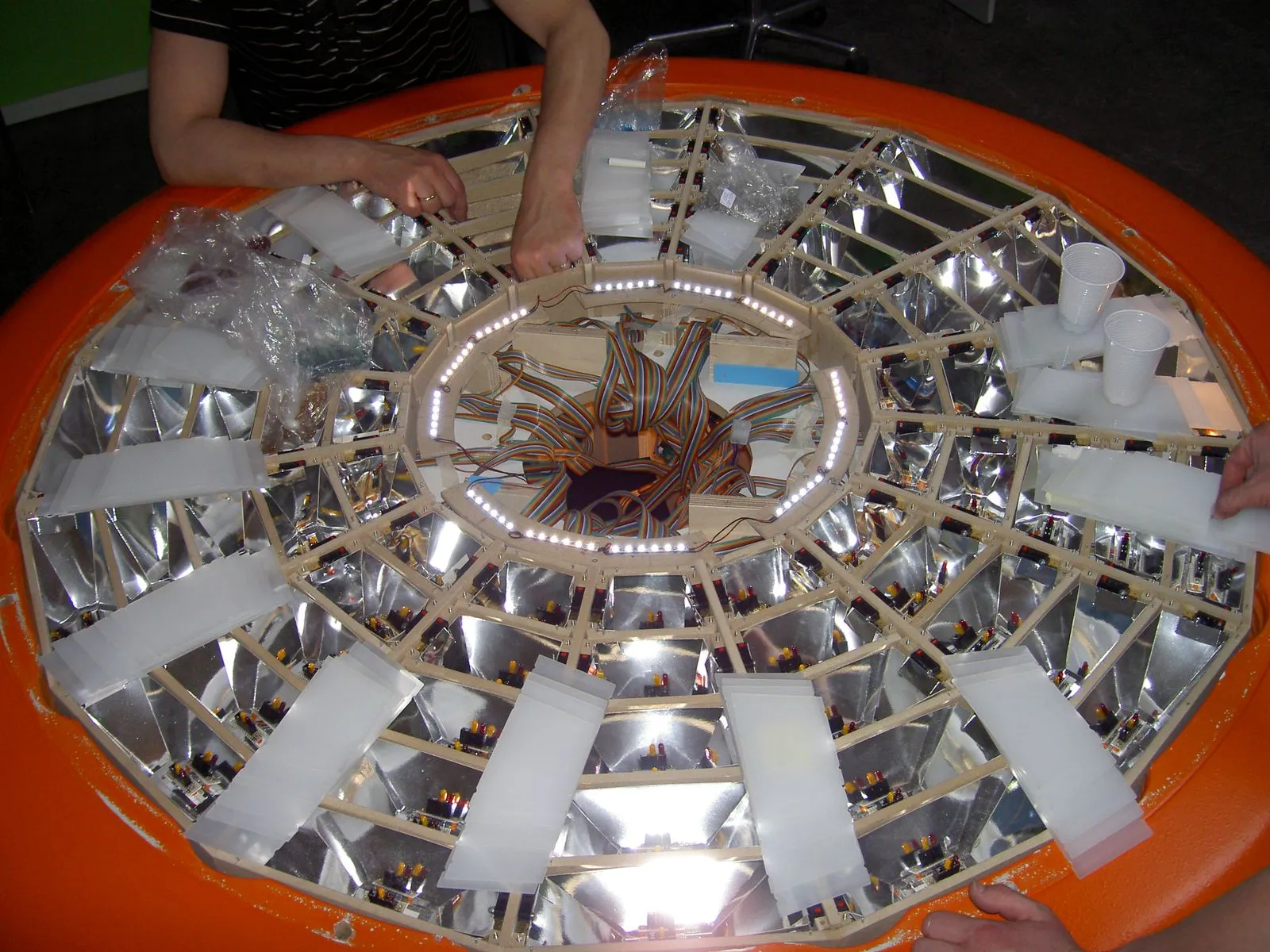
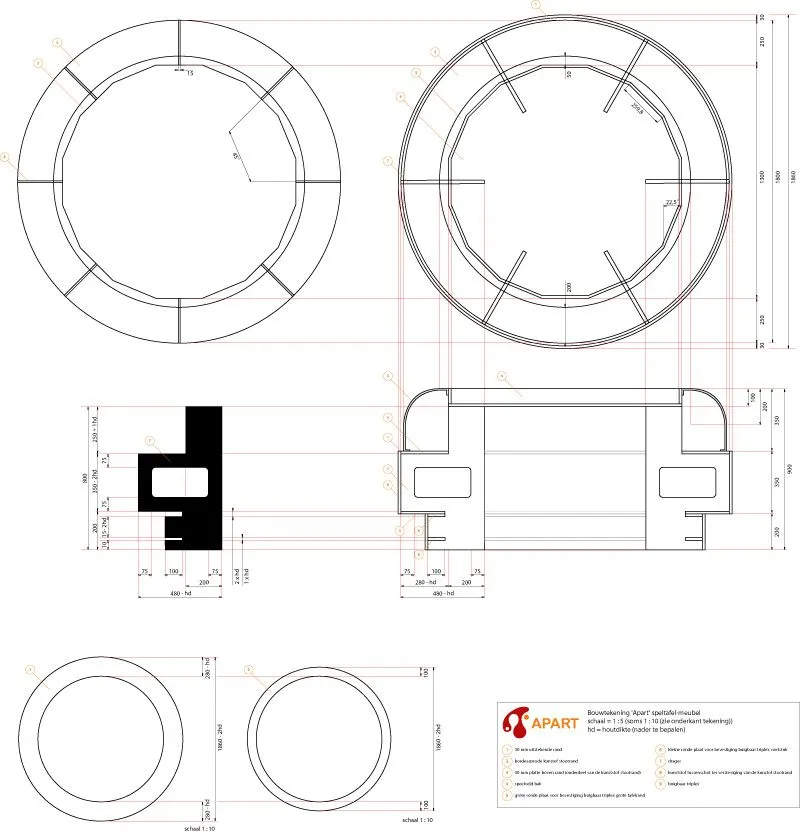
Playing field. 16 columns of 5 rows, 80 cells in all, each cell smaller than the one outside it. Three colours per cell, so 240 lamps at 1.2 W each. Two microswitches per cell wired in parallel, 160 in total, so the whole cell acts as one button. Lids are 3 mm opal white acrylic. Four start/stop buttons, and a 15” TFT in the centre for game information. Housing in MDF, splash-proof, with the outer rim rounded for reach and for looks.
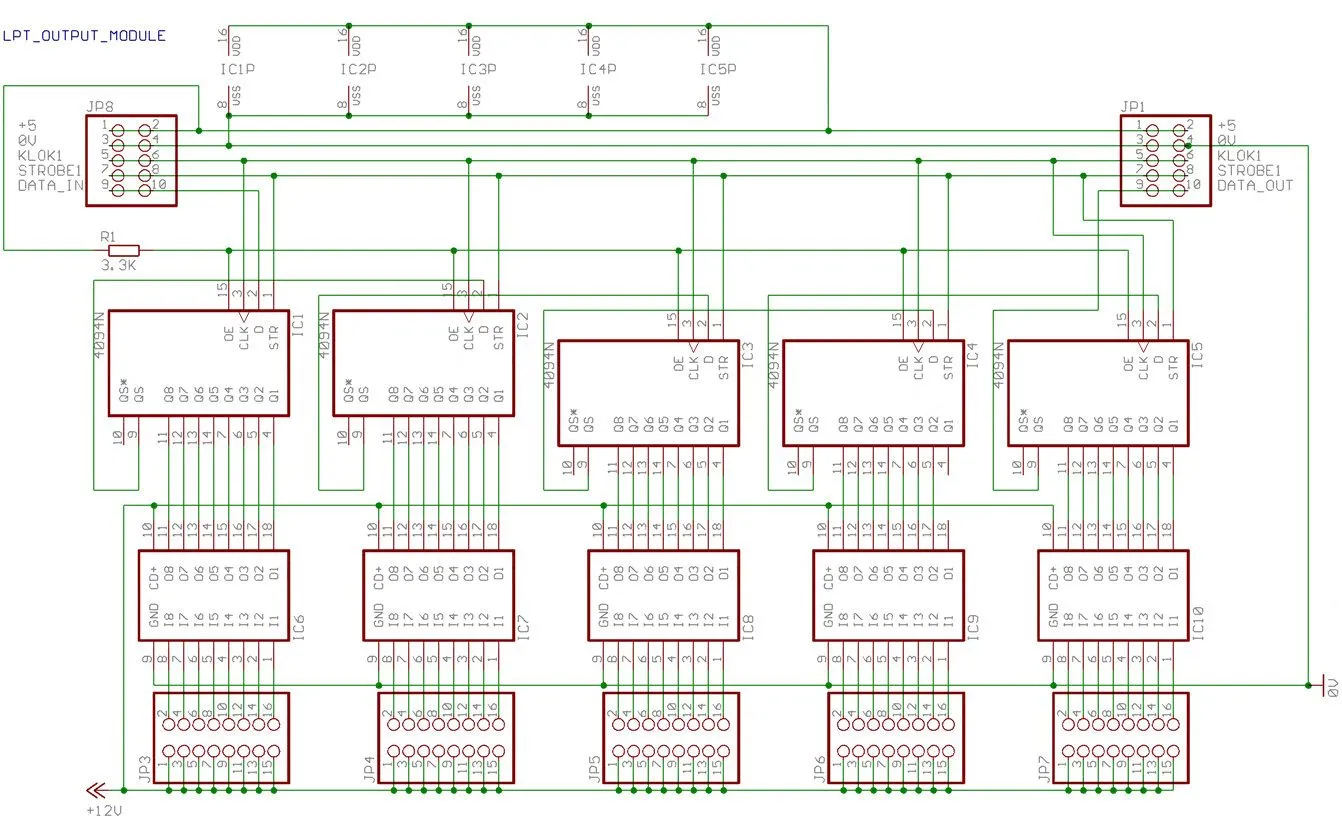
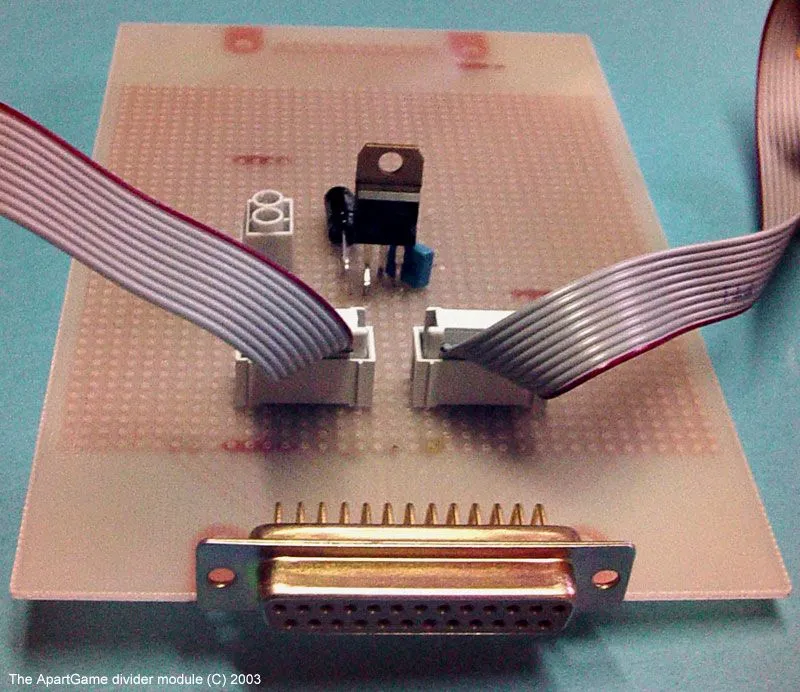
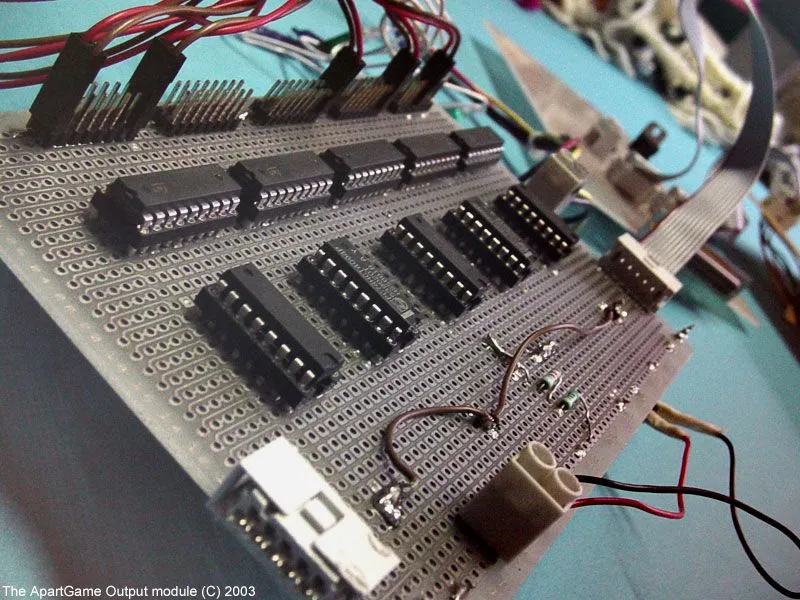
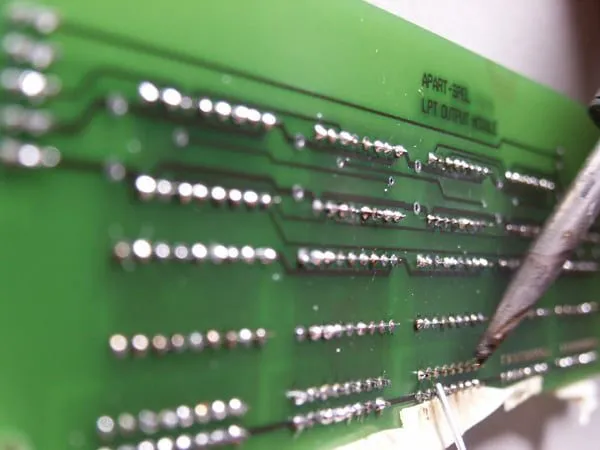
Control electronics. Everything runs over a PC parallel port, using its data lines directly rather than the LPT handshake standards. Output: 30 × 74HCT4094 shift registers driving ULN2803A arrays. Input: 12 × 74HCT165 shift registers giving 96 inputs, of which 80 are cells, 4 start/stop and 12 spare. Two separate supplies: 12 V for the lamps on their own loom, 5 V for the ICs and pull-ups. Shift registers were split into modules by function and count, both to vary the number of lamps and buttons and to keep the cable runs short.
Software. Macromedia Director with a purpose-built Xtra, on an Intel Celeron 500 MHz with 128 MB RAM and Windows 98. The Xtra reads the serial chain 12 times a second and writes it 30 times a second; a bit’s position in the string is what identifies a given lamp or button.
Planned product line
| Prototype | Standard | DLX | |
|---|---|---|---|
| Cells | 80 | 80 | 80 |
| Colours | 3 | 5 | 5…n |
| Light source | Incandescent | LED | LED |
| Diameter | 185 cm | ~115 cm | 185 cm |
| Touchscreen | No | Yes | Yes |
| JVH back office | No | Yes | Yes |
| Market | n/a | Hospitality | Clubs, venues, events |
| Target cost | n/a | €3000 | €5000 |
(The table is 185 cm across, as specified here. The IUI ’07 paper gives 175 cm, which is an error in the paper.)
Who built it
Bas van Abel, Tyz (Thijse) Broerse, Roel Creemers and Dirk van de Mortel.
The platform was written up with Jun Hu as ApartGame: a Multi-User Tabletop Game Platform for Intensive Public Use, IUI ’07, Honolulu.
What came of it
It was shown at 39 venues and events, from Dutch Design Week and Cinekid to bars, resorts and trade fairs, and picked up seventeen press, radio and television appearances along the way. It reached a production version and a product line as O-Dynamic Games, which is further than most graduation projects get.